
2026 Buyer’s Guide • Updated October 2026
Payroll Services: What’s Included, What They Cost & How to Choose
Compare full-service payroll, online payroll software and PEOs side by side, see 2026 pricing from the top payroll companies, and get free quotes from providers that fit your business.
Compare Payroll Quotes → See 2026 Pricing
What Are Payroll Services?
Payroll services are third-party companies that pay your employees and handle the payroll taxes for you. A payroll service calculates gross-to-net pay, withholds and deposits federal, state and local taxes, sends direct deposits, files quarterly and year-end forms (941, 940, W-2 and 1099), and keeps compliant payroll records. Most small businesses pay a base fee of about $17–$50 per month plus $4–$7 per employee.
Not sure which type fits you? Tell us about your business and we’ll match you with payroll companies that serve your size and industry.
Ready to hand payroll off? Our payroll outsourcing services guide covers what you hand off vs. keep, who’s liable for payroll taxes and how to switch providers in 6 steps.
Want hours and benefit deductions to flow into payroll automatically? See our guide to time, attendance and benefits integration, or explore HR and workforce services that bundle hiring, compliance and benefits with payroll.
On this page
What’s Included in Payroll Services?
A full-service payroll provider takes over every recurring payroll task. Here is what you should expect in a standard plan, and what usually costs extra.
Payroll Processing
Gross-to-net pay for hourly, salaried, overtime, tips and bonuses on any schedule. Learn about payroll outsourcing services.
Payroll Tax Filing
Tax deposits plus Forms 941, 940, state returns, W-2s and 1099s filed on time. See payroll tax filing services.
Direct Deposit
Paychecks deposited to employee bank accounts, often with next-day or same-day options. Compare direct deposit services.
Compliance Support
Automatic tax-table updates, new-hire reporting, minimum wage and overtime rules by state.
Employee Self-Service
Online portal or app for pay stubs, W-2s, W-4 updates and onboarding paperwork.
Reports & Records
Payroll registers, labor-cost and tax liability reports, plus accounting integrations.
Often extra: time and attendance, HR support, benefits administration, workers’ comp, 401(k) plans, multi-state filing (on some plans) and off-cycle payroll runs.
Types of Payroll Services
There are four main ways to run payroll. The right one depends on how much control you want, how many employees you have, and whether you also need HR and benefits help. For a deeper look at the tradeoffs, read our analysis of whether outsourcing payroll is worth it.
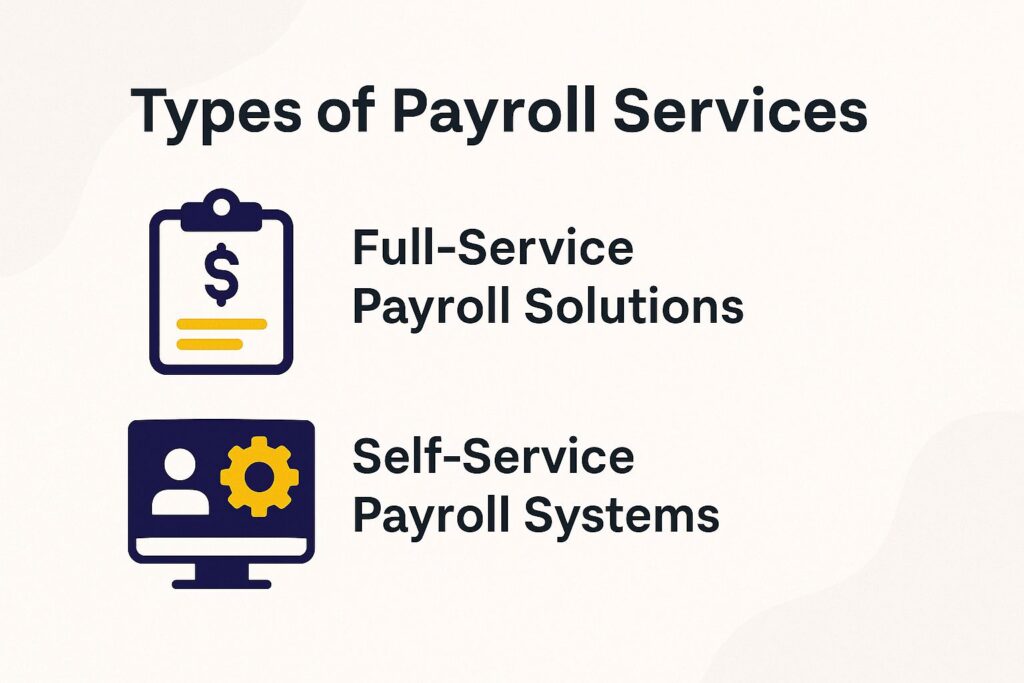
| Type | Who does the work | Typical cost | Best for |
|---|---|---|---|
| Full-service payroll | Provider runs payroll, deposits and files all taxes | $29–$50/mo + $5–$7 per employee | Most small and midsize businesses |
| Online payroll software (DIY) | You enter hours and approve; software calculates (tax filing may be extra) | $17–$20/mo + $4 per employee | Very small teams comfortable with filings |
| PEO (co-employment) | PEO handles payroll, HR, benefits and workers’ comp as co-employer | Often $100+ per employee/mo or a % of payroll | Businesses that want big-company benefits |
| In-house payroll | Your staff calculates, pays and files everything | Staff time + software + penalty risk | Large firms with a payroll department |
Payroll service vs. payroll software: a payroll service takes responsibility for filing and depositing your taxes; payroll software gives you the tools to do it yourself. Many brands sell both, so check whether “tax filing” is included in the plan you’re quoted. Browse our payroll software guide if you want to run payroll yourself.
Payroll service vs. PEO: a payroll service works for you, and you stay the sole employer. A PEO becomes a co-employer, which lets small companies buy health insurance and workers’ comp at group rates, but costs considerably more.
Get matched with payroll services that fit your team size and budget — free, in about 2 minutes.
Outsource Payroll From $4/EmployeeHow Much Do Payroll Services Cost in 2026?
Most payroll services charge a monthly base fee of $17–$50 plus $4–$7 per employee. Full-service plans that file your taxes generally start around $29–$50 per month plus $5–$7 per employee. Providers such as ADP, Paychex and Rippling quote custom pricing based on headcount, pay frequency and add-ons.
| Payroll provider | Starting price | Tax filing included | Best for |
|---|---|---|---|
| Gusto | $49/mo + $6/employee | Yes | Modern payroll + HR |
| OnPay | $49/mo + $6/employee | Yes | Multi-state, all-in-one pricing |
| QuickBooks Payroll | $50/mo + $6.50/employee | Yes | QuickBooks Online users |
| SurePayroll | $29/mo + $7/employee (full service) | Yes | Small teams, household employers |
| Patriot Payroll | $17/mo + $4/employee (basic) | Full Service plan only | Lowest-cost option |
| ADP RUN | Custom quote | Yes | Growing companies, HR depth |
| Paychex Flex | Custom quote (priced per payroll run) | Yes | Dedicated specialist, payroll + HR |
| Rippling | Custom quote | Yes | Payroll + HR + IT in one system |
Published list prices as of mid-2026; providers change pricing and run promotions, so confirm with a current quote.
What raises your price: weekly pay schedules (with per-run pricing), employees in multiple states, tipped or union workers, certified payroll for government contracts, off-cycle bonus runs, and add-ons like time tracking, HR or benefits administration.
For a complete breakdown of fees, setup charges and hidden costs, see our payroll outsourcing cost guide.
How Do Payroll Services Work?
Once you’re set up, a typical pay cycle takes only a few minutes of your time.
Set up your company
Share your EIN, state tax IDs, bank account, pay schedule and prior payroll history.
Onboard employees
Employees enter W-4, I-9 and direct deposit details through the provider’s portal.
Submit hours
Enter or sync hours, overtime, PTO and bonuses each pay period, or turn on auto-payroll.
Employees get paid
The provider debits your account and sends direct deposits and pay stubs.
Taxes get filed
Tax deposits, quarterly returns and year-end W-2s and 1099s are filed for you.

2026 Payroll Taxes a Payroll Service Handles
These are the federal payroll taxes your provider calculates, withholds and deposits every pay period. State and local income and unemployment taxes are handled too, and vary by location.
| Tax | Employer | Employee | 2026 wage base |
|---|---|---|---|
| Social Security | 6.2% | 6.2% | First $184,500 of wages |
| Medicare | 1.45% | 1.45% (+0.9% over $200,000) | No cap |
| FUTA (federal unemployment) | 6.0% (usually 0.6% after state credit) | None | First $7,000 of wages |
| SUTA (state unemployment) | Varies by state | A few states | Set by each state |
| Federal income tax | None | Withheld per Form W-4 | IRS Publication 15-T tables |
Payroll Services by Business Size & Industry
Payroll needs change with headcount and industry rules like tip reporting, certified payroll and clergy housing allowances. Find the guide that matches your business.
Benefits of Using a Payroll Service (and the Tradeoffs)
✔ Benefits
- Saves hours every pay period on calculations, deposits and filings.
- Fewer costly errors with automatic tax-table and wage-law updates.
- On-time tax deposits that help you avoid IRS and state penalties.
- Employee self-service for pay stubs, W-2s and onboarding.
- Scales with you as you add employees, states or benefits.
⚠ Tradeoffs
- Monthly cost that grows with each employee you add.
- Add-on fees for HR, time tracking or extra payroll runs.
- You’re still liable for payroll taxes if a provider fails to pay them.
- Less hands-on control over processing deadlines.
- Switching takes planning, ideally at the start of a quarter.
How to Choose the Best Payroll Service
Use this checklist when you compare providers and quotes.
- Confirm what’s included. Make sure federal, state and local tax filing, W-2s and 1099s are part of the quoted price.
- Ask how pricing works. Unlimited payroll runs versus per-run pricing can change your bill a lot if you pay weekly.
- Check multi-state and contractor support if you have remote workers or 1099 contractors.
- Look for a tax accuracy guarantee that covers penalties caused by the provider’s errors.
- Test the support. Ask about phone hours, a dedicated rep and average response times.
- Verify integrations with your accounting software, time clock and POS.
- Get at least three quotes. Prices for the same headcount can vary by hundreds of dollars a year.
Read our in-depth reviews before you decide:





See all payroll company reviews, or find payroll services near you.
Payroll Services FAQs
What are payroll services?
Payroll services are third-party companies that pay your employees and handle payroll taxes for you. They calculate wages and withholdings, send direct deposits, deposit and file federal, state and local payroll taxes, issue W-2s and 1099s, and keep compliant payroll records.
How much do payroll services cost per month?
Most payroll services charge a base fee of $17 to $50 per month plus $4 to $7 per employee. A 10-person business on a typical $49 plus $6 per employee full-service plan pays about $109 per month. ADP, Paychex and Rippling quote custom pricing.
What is included in full-service payroll?
Full-service payroll includes payroll processing, direct deposit, tax withholding, federal, state and local tax deposits and filings, year-end W-2 and 1099 forms, new-hire reporting and an employee self-service portal. Time tracking, HR support and benefits administration are usually add-ons.
Are payroll services worth it for a small business?
For most small businesses, yes. A payroll service saves several hours per pay period and reduces the risk of IRS late-deposit penalties of 2% to 15%, which can easily exceed the roughly $80 to $200 per month a small team pays for full-service payroll.
What is the difference between a payroll service and payroll software?
A payroll service takes responsibility for running payroll and filing your payroll taxes. Payroll software gives you tools to calculate payroll yourself, and some lower-cost software plans leave tax filing to you. Many providers sell both, so confirm tax filing is included in your quote.
What is the difference between a payroll service and a PEO?
A payroll service processes payroll while you remain the only employer. A PEO becomes a co-employer and bundles payroll with HR, workers’ compensation and group health benefits. PEOs typically cost more but give small businesses access to large-group benefit rates.
Who is responsible if a payroll service makes a tax mistake?
The employer remains legally responsible for payroll taxes even when a payroll service files them. That is why you should choose a provider with a tax accuracy guarantee and periodically confirm deposits in your IRS EFTPS account.
Can payroll services pay contractors and employees in other states?
Yes. Most payroll services can pay 1099 contractors and handle multi-state payroll, registering and filing in each state where employees work. Some providers include multi-state filing in every plan, while others charge more for it.
How long does it take to switch payroll providers?
Switching usually takes one to three weeks. Many providers migrate your year-to-date payroll data for free, and starting at the beginning of a quarter keeps quarterly tax filings simple.
How do I choose the best payroll service?
Compare what each plan includes, how pricing works for your pay schedule, multi-state and contractor support, tax accuracy guarantees, customer support and integrations with your accounting software. Getting at least three quotes is the fastest way to find the best price for your headcount.
Compare Payroll Services and Save
Answer a few quick questions and get free, no-obligation quotes from payroll companies that serve businesses like yours.
Get Free Payroll Quotes →Free to use • No obligation • Takes about 2 minutes