
2026 Guide • Updated October 2026
Payroll Outsourcing Services: How to Outsource Payroll in 2026
What you hand off and what you keep, who’s liable for payroll taxes, what it costs, the top providers and a step-by-step plan to switch without missing a paycheck.
Compare Payroll Outsourcing Quotes → How to Outsource in 6 StepsWhat Are Payroll Outsourcing Services?
Payroll outsourcing services are when you hire an outside company to run your payroll: it calculates pay, pays employees by direct deposit, deposits and files payroll taxes, and prepares W-2s and 1099s, while you submit hours and approve each payroll. Most small businesses pay $29–$50 per month plus $5–$7 per employee, mid-sized companies $12–$30 per employee per month, and PEOs about $100–$250 per employee per month.
Important: your business stays legally responsible for federal payroll taxes unless you use an IRS-certified PEO (CPEO).
On this page
What You Hand Off vs. What You Keep
When you outsource payroll, the provider handles the calculations, payments, tax deposits and filings, while you stay responsible for accurate hours, pay changes and approving each payroll. Here’s how the work typically splits.
| Payroll task | Payroll outsourcing provider | Your business |
|---|---|---|
| Calculate gross-to-net pay, overtime and deductions | ✓ | Approve each payroll |
| Pay employees by direct deposit or check | ✓ | Fund the payroll account |
| Withhold and deposit federal, state and local payroll taxes | ✓ | Stay legally liable (unless you use a CPEO) |
| File Forms 941, 940 and state returns | ✓ | Review filings and notices |
| Year-end W-2s and 1099s | ✓ | Confirm addresses and contractor info |
| New hire reporting and garnishments | ✓ | Send new hire and garnishment paperwork |
| Hours, pay rates, raises and terminations | — | Submit accurate data on time |
| Benefits deductions and 401(k) remittance | Often included or an add-on | Choose plans and enroll employees |
The provider’s work includes payroll tax filing and direct deposit. For a broader overview of every type of payroll service, see our payroll services guide.
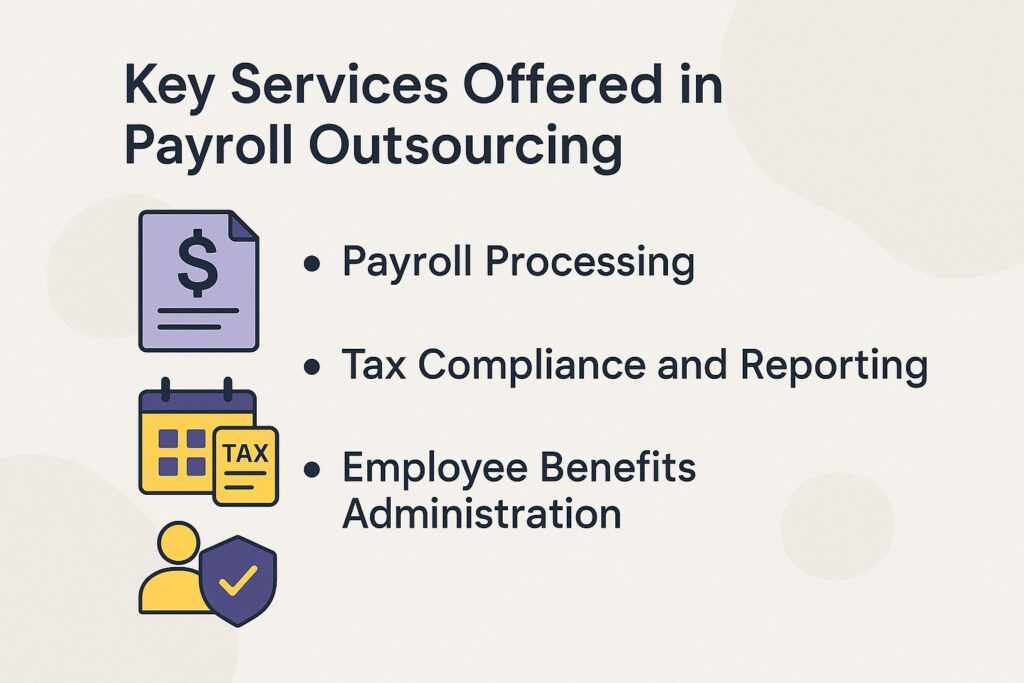
4 Levels of Payroll Outsourcing
How much you outsource decides your cost and who carries the tax liability.
| Outsourcing level | What the provider does | Who’s liable for payroll taxes | Typical 2026 cost | Best for |
|---|---|---|---|---|
| Online payroll with tax filing | Software calculates, deposits and files; you enter hours and approve | Your business | $29–$50/mo + $5–$7 per employee | Small businesses comfortable running payroll themselves |
| Fully managed payroll | A payroll specialist runs payroll for you, handles notices and answers employee questions | Your business | Higher tiers or $12–$30 per employee/mo | Busy owners and mid-sized teams |
| PEO (co-employment) | Payroll plus HR, workers’ comp and large-group benefits as a co-employer | Shared; an IRS-certified PEO (CPEO) takes on federal employment taxes | ~$100–$250 per employee/mo | Companies that want HR and benefits outsourced too |
| Employer of record (EOR) | Legally employs your workers in other countries and runs local payroll | The EOR | From ~$499 per employee/mo | Hiring abroad without a local entity |
Not sure which level fits? Tell us about your business and compare payroll outsourcing quotes in about 2 minutes.
Get Free Quotes7 Signs It’s Time to Outsource Payroll
You’re hiring your first employees or growing quickly.
You’ve added workers in another state.
You’ve received an IRS or state tax notice or penalty.
Payroll takes more than a few hours each month.
The one person who knows payroll is leaving.
You pay hourly, tipped or overtime workers on varying schedules.
You want benefits or HR help without hiring staff.
Still deciding? Read why outsourcing your payroll can be beneficial and our breakdown of whether outsourcing payroll is worth it.
In-House vs. Outsourced Payroll
Outsourcing usually costs less than doing payroll in-house for businesses under 500 employees once you count staff time and penalty risk.
| Keep payroll in-house | Outsource payroll | |
|---|---|---|
| Who does the work | You or your staff | The provider; you approve |
| Time each pay period | Hours of calculations, deposits and forms | Minutes to review and approve |
| Direct cost | Software plus staff time (a payroll clerk earns a median of about $58,260 a year) | About $87–$120/mo for 10 employees on full service |
| Tax law updates | You track them | Built in |
| Penalty risk | All on you | Lower; many providers guarantee tax accuracy |
See full price breakdowns by team size in our payroll outsourcing cost guide.
How to Outsource Payroll in 6 Steps
To outsource payroll, define what you need, compare quotes, gather your payroll data, authorize the provider, run a parallel payroll and verify your first tax deposits.
Define what you want to outsource
Decide whether you need payroll and tax filing only, a fully managed service, or payroll plus HR and benefits through a PEO, and set a monthly budget.
Compare at least three quotes
Ask each provider for an itemized quote covering base fees, per-employee fees, year-end forms, extra states and setup, plus contract length and cancellation terms.
Gather your payroll data
Collect your EIN, state tax account numbers and rates, deposit schedule, employee W-4s and state forms, pay rates, direct deposit details, benefit deductions and year-to-date wages and taxes.
Authorize your new provider
Sign IRS Form 8655 (Reporting Agent Authorization) and any state power-of-attorney forms so the provider can file and deposit taxes for you.
Pick a start date and run a parallel payroll
Starting at the beginning of a quarter keeps filings clean. Run one payroll in both systems and compare the results before going live.
Go live and verify
Check the first payroll register, enroll in EFTPS with your own PIN to confirm federal tax deposits, and keep your business address on file with the IRS.
Who’s Liable When You Outsource Payroll?
The IRS says the employer is ultimately responsible for depositing and paying federal payroll taxes, even when a payroll provider handles them. If a provider fails to pay, penalties and interest can land on your business, and owners can be held personally liable for unpaid withheld taxes. The main exception is an IRS-certified PEO.
| Arrangement | How it works | Who’s liable for federal payroll taxes |
|---|---|---|
| Payroll service provider (PSP) | Prepares payroll and tax filings for your business | You |
| Reporting agent (Form 8655) | You authorize the provider to sign and file returns and make deposits for you | You |
| Section 3504 agent | Acts as the employer for tax purposes for specific employees | Agent and employer share liability |
| Certified PEO (CPEO) | IRS-certified PEO that pays wages to your worksite employees | The CPEO, for wages it pays |
🛡 How to protect your business
- Enroll in EFTPS with your own PIN and check that federal deposits are made on time.
- Keep your own business address on file with the IRS, not the provider’s.
- Treat a single missed or late tax payment as a red flag.
- Ask for the provider’s SOC 1 Type II report and tax accuracy guarantee in writing.
How to Choose a Payroll Outsourcing Provider
What to compare
- Total monthly cost for your headcount and pay frequency
- Tax filing coverage: federal, state, local and extra states
- Support model: shared queue or a dedicated specialist
- Tax accuracy guarantee and penalty coverage
- Integrations with your accounting, time and benefits tools
- Contract length, cancellation terms and renewal increases
Questions to ask
- Who runs my payroll if my contact is out?
- How fast do you respond to IRS or state notices?
- What happens if you make a tax filing mistake?
- Do you have a current SOC 1 Type II report?
- Is setup or data migration free?
- How do I get my data back if I leave?
Top Payroll Outsourcing Providers
Popular payroll outsourcing companies and their 2026 starting prices. See the full rankings of the best payroll outsourcing companies or the best payroll software.

 Best for dedicated payroll support
Paychex
Starting price: Custom quote (priced per payroll run)
 Best for small businesses
Gusto
Starting price: $49/mo + $6/employee
 Best value full-service payroll
OnPay
Starting price: $49/mo + $6/employee
 Best for HR-focused growing companies
Paycor
Starting price: Custom quote
 Best full-service PEO
Insperity
Starting price: Custom quote (PEO, % of payroll)
By company size: small business payroll outsourcing • mid-sized business payroll outsourcing. By industry: restaurants, construction, nonprofits, churches and manufacturing.
Payroll Outsourcing Services FAQs
What are payroll outsourcing services?
Payroll outsourcing services are when a business hires an outside company to run its payroll. The provider calculates pay and withholdings, pays employees by direct deposit, deposits and files payroll taxes, and prepares year-end W-2s and 1099s, while the business submits hours and approves each payroll.
What is included in payroll outsourcing?
Most payroll outsourcing services include payroll processing, direct deposit, federal, state and local tax deposits and filings, quarterly Form 941 and annual Form 940 returns, W-2s and 1099s, new hire reporting, wage garnishments and an employee self-service portal. Time tracking, benefits administration and HR support are often add-ons.
How much do payroll outsourcing services cost?
Most small businesses pay $29 to $50 per month plus $5 to $7 per employee for full-service payroll, or about $87 to $120 per month for 10 employees. Mid-sized companies typically pay $12 to $30 per employee per month, and a PEO costs roughly $100 to $250 per employee per month.
Is it worth outsourcing payroll?
For most businesses with fewer than 500 employees, yes. Outsourcing usually costs less than a payroll employee or the owner’s time, keeps up with tax law changes automatically, and lowers the risk of late-deposit penalties, which run from 2% to 15% of the unpaid tax.
Am I still liable for payroll taxes if I outsource payroll?
Yes, in most cases. The IRS holds the employer ultimately responsible for depositing and paying federal payroll taxes even when a payroll service provider handles them. The main exception is an IRS-certified PEO, which takes on liability for federal employment taxes on the wages it pays.
What is the difference between payroll outsourcing and a PEO?
A payroll outsourcing company runs payroll and files taxes while your business remains the only employer. A PEO becomes a co-employer, adding HR support, workers’ compensation and access to large-group benefits, which is why PEOs cost more per employee.
What is the difference between payroll outsourcing and payroll software?
Payroll software calculates pay and may file taxes, but you run each payroll yourself. Full payroll outsourcing hands more of the work to the provider, often including a dedicated specialist who processes payroll and resolves tax notices for you.
How long does it take to outsource payroll?
Small businesses can usually switch to an online payroll provider in one to three weeks. Mid-sized companies moving to a managed or HCM provider typically need four to twelve weeks, including data migration and a parallel payroll run.
When should a small business outsource payroll?
Consider outsourcing payroll when you hire your first employees, add workers in another state, receive a tax notice or penalty, spend more than a few hours a month on payroll, or lose the person who has been running it.
What information does a payroll provider need?
Providers need your EIN, state tax account numbers and unemployment rates, your federal deposit schedule, employee W-4s and state withholding forms, pay rates and schedules, direct deposit details, benefit deductions and year-to-date wages and taxes if you switch mid-year.
What is IRS Form 8655?
Form 8655, Reporting Agent Authorization, lets a payroll provider sign and file certain federal payroll tax returns and make tax deposits on your behalf. Signing it does not transfer your liability for the taxes.
Can I outsource payroll for employees in other states or countries?
Yes. Most payroll outsourcing services handle multi-state payroll, though some charge per additional state. For employees in other countries, you can use a global payroll provider if you have a local entity or an employer of record if you don’t.
Ready to Outsource Your Payroll?
Get free, no-obligation quotes from payroll outsourcing companies that serve your size and industry.
Get Free Payroll Quotes →Free to use • No obligation • Takes about 2 minutes