
Do Contracted Workers Go on Payroll? Here’s What the IRS Says
You hire a freelancer to improve your project, but then receive a notice from the IRS requiring payment of past due taxes. Misclassifying workers isn’t just a paperwork slip-it’s a costly trap that could drain your business. Learn the IRS’s clear policy: When can contractors avoid payroll, and when must they be on it? We’ll unpack classification tests, tax rules, tax implications, and risks to keep you compliant and confident, ensuring proper employee classification and worker status.
Defining Contracted Workers
Contracted workers, often called independent contractors or freelancers, are individuals you hire for specific projects without the long-term commitment of employment, like a graphic designer charging $50/hour via Upwork.
According to IRS Revenue Ruling 87-41, independent contractors are distinguished from employees primarily by the lack of benefits like health insurance or paid leave, allowing businesses to avoid payroll taxes. For instance, a marketing consultant on a 6-month contract might deliver a campaign strategy independently, unlike a full-time staffer integrated into daily operations.
The DOL’s economic reality test clarifies status by assessing control and dependency. Key traits include:
- Project-based work with defined deliverables and timelines.
- Use of their own tools, such as Adobe Suite for designers.
- Serving multiple clients to diversify income, reducing reliance on one employer.
Understanding Payroll Fundamentals
Payroll involves processing wages, deductions, and taxes for employees, such as withholding 7.65% FICA taxes on your team’s salaries using software like QuickBooks Payroll at $45/month.
- Begin with gross pay calculation: for a salaried worker earning $60,000 annually, divide by 26 pay periods to get $2,307.69 bi-weekly.
- Subtract federal withholdings (e.g., 22% income tax bracket yields about $507), state taxes (varies, e.g., 5% in California), and the employee’s 7.65% FICA share ($176).
- Employers must match FICA: 6.2% Social Security ($143) and 1.45% Medicare ($33), totaling $4,580 yearly for this example.
- Comply with FLSA’s $7.25/hour minimum wage.
- Check IRS Publication 15 for tables and ways to avoid penalties.
Why Classification Matters for Businesses
Misclassifying a worker can cost your business thousands in back taxes, as seen in the 2022 IRS case against Uber where $1.1 million in penalties were assessed for 1099 drivers reclassified as employees.
To avoid such pitfalls, businesses must correctly classify workers using IRS Form SS-8 for guidance or consulting DOL’s economic reality test, which examines control, integration, and permanence. Explore the ultimate employee classification checklist for 2025 to ensure accurate assessments and compliance.
- Key impacts include: tax savings from avoiding FICA contributions (15.3% on wages for contractors, per IRS rules);
- legal risks like FLSA overtime violations, leading to lawsuits under EEOC guidelines on worker rights;
- and operational burdens such as denying benefits like health insurance.
Proper classification yields strong ROI-a SHRM study shows it saves 20% on payroll costs by preventing reclassification fines and boosting compliance.
IRS View on Classifying Workers
The IRS views worker classification through a lens of control and independence, with over 3 million Form SS-8 requests filed since 2010 to determine status. Those curious about applying these principles in practice might appreciate our Ultimate Employee Classification Checklist for 2025.
Employee vs. Independent Contractor: Key Differences
Employees receive W-2 forms and benefits like 401(k) matching, while independent contractors get 1099s and handle their own taxes, as in Microsoft’s 2019 settlement paying $97 million for misclassifying 1099 workers.
To distinguish properly, consider this comparison:
| Attribute | Employees (W-2) | Contractors (1099) |
|---|---|---|
| Tax Forms & Withholding | W-2 issued; employer withholds taxes | 1099 issued; self-withhold taxes |
| Benefits | Health insurance, 401(k) matching | None provided; self-funded |
| Schedule | Fixed hours set by employer | Own flexible schedule |
| Clients | Exclusive to one employer | Multiple clients allowed |
Use cases include hiring employees for core roles like full-time developers needing ongoing supervision, issuing Form W-2 and handling withholding taxes, or contractors for one-off projects such as IT consulting gigs, issuing Form 1099 for non-employee compensation.
A third: seasonal marketing specialists as contractors to avoid fixed costs.
Per IRS common law rules, classification hinges on behavioral/financial control and relationship type-missteps risk audits and penalties.
Common Misconceptions About Contractors
Many assume labeling a worker as a ‘contractor’ in an agreement shields you from payroll taxes, but the IRS disagreed in the 2021 FedEx case, reclassifying 1,500 drivers and imposing $228 million in liabilities.
This highlights common misconceptions about contractor classification. To avoid reclassification risks, clarify these:
- **Verbal agreements suffice**: No-draft a written scope of work outlining tasks, deadlines, and independence to prove non-employee status.
- **Contractors can’t work remotely**: They can, but excessive control (e.g., dictating tools or hours) signals employment; allow flexibility in methods.
- **No benefits mean no employment**: Incorrect-IRS examines behavioral control and integration into your business, per DOL Fact Sheet #13.
- **Short-term equals contractor**: Duration matters less than permanency; ongoing relationships may indicate employee status.
Consult IRS Form SS-8 for determinations.
Do Contracted Workers Go on Payroll? The IRS Answer
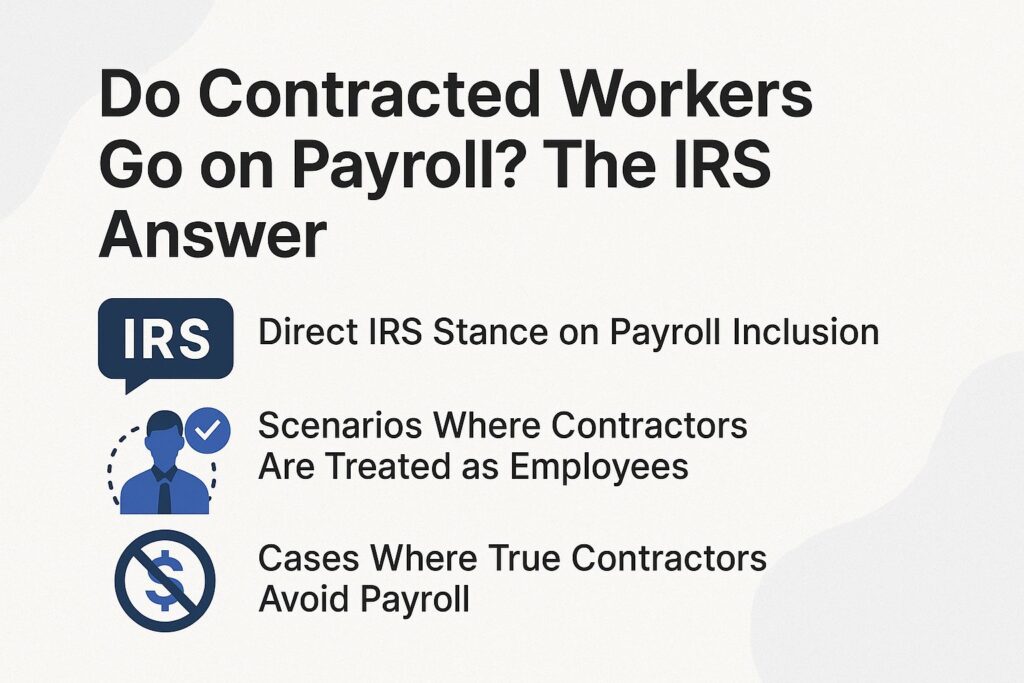
According to IRS guidelines, true independent contractors do not go on payroll, but misclassified ones can trigger back payments averaging $50,000 per worker from audits.
Direct IRS Stance on Payroll Inclusion
The IRS clearly states in Publication 1779 that independent contractors are not added to payroll, but you must withhold for employees under IRC Section 3401.
To classify workers correctly, consider the IRS rule: ‘If you have the right to control what work is done and how, they’re employees.’ This hinges on behavioral control (instructions given), financial control (unreimbursed expenses), and relationship type (benefits provided).
For uncertainty, file Form SS-8 with the IRS for a determination, which typically takes 6-8 months to process.
For example, a marketing consultant with full autonomy over methods and hours remains independent, avoiding payroll taxes, while one under daily supervision and using company tools qualifies as an employee.
See Revenue Ruling 70-309 for detailed criteria on control factors.
Scenarios Where Contractors Are Treated as Employees
In scenarios like providing company tools and setting daily hours, the IRS treated Dynamex’s delivery drivers as employees in the 2018 California case, leading to $13 million in settlements.
To avoid misclassification under California’s AB5 law, which adopts the ABC test from Dynamex, consider these three scenarios:
- Behavioral Control: Dictating methods, like requiring sales scripts, fails ABC prong A (lack of direction/control). IRS common law ties this to employee status via supervision.Tip: Grant autonomy in how tasks are completed, documenting independent decision-making.
- Financial Dependency: Relying on one exclusive client without personal investment violates ABC prong B (independent trade). IRS views this as non-entrepreneurial.Tip: Diversify clients and invest in your own tools/equipment to show business viability.
- Indefinite Relationship: Ongoing work without end dates suggests employment under ABC prong C (customary engagement elsewhere). IRS factors in permanency.Tip: Use fixed-term contracts with clear end dates and allow workers to serve multiple entities.
Cases Where True Contractors Avoid Payroll
True contractors like freelance writers using their own laptops and serving multiple clients avoid payroll, as affirmed in the IRS’s favorable determination for a 2023 marketing firm via Form SS-8.
To classify as a true independent contractor under IRS common law safe harbor rules, consider these three key cases:
- Project-based with fixed price: Charge a set fee, like $5,000 for building a complete website, without hourly tracking-evidenced in IRS Revenue Ruling 87-41.
- Own business entity: Operate as an LLC and file Schedule C for taxes, separating personal and business finances, as seen in the 2023 Form SS-8 ruling for the marketing firm.
- No supervision: Deliver self-directed work, such as monthly reports without client oversight, aligning with behavioral control factors in IRS guidelines.
This approach yields success metrics like zero back taxes in audited cases, per SHRM’s 2022 workforce compliance study, ensuring legal protection and financial independence.
IRS Classification Tests
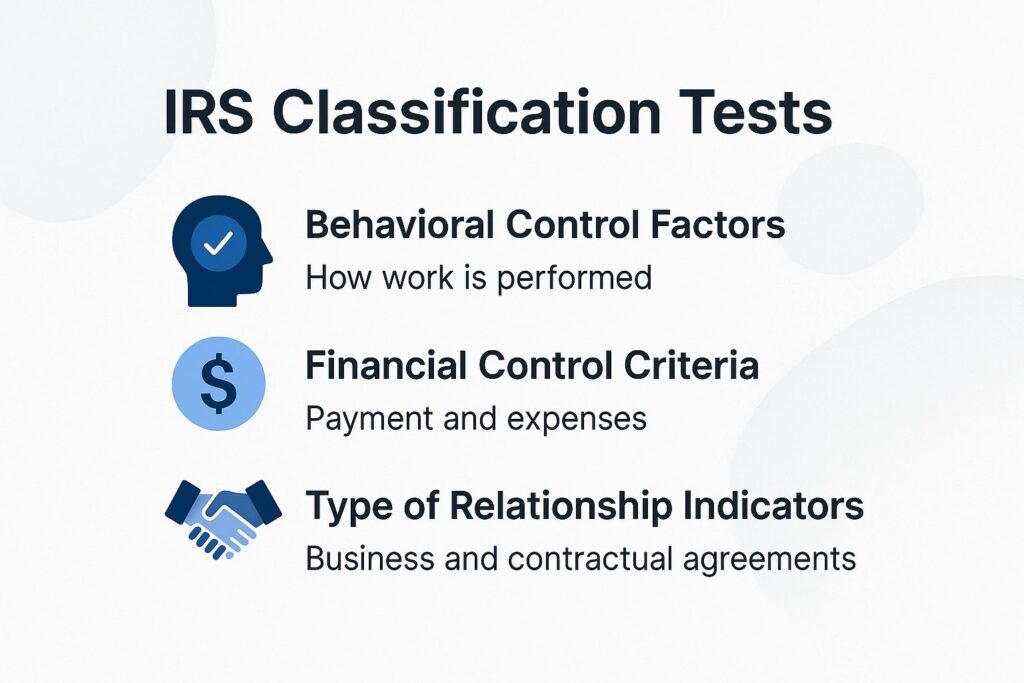
The IRS uses three-pronged tests to classify workers, with behavioral control being the most litigated factor in over 40% of disputes according to a 2023 Tax Foundation study. For a practical deep dive into applying these tests effectively, our Ultimate Employee Classification Checklist for 2025 breaks down essential steps and best practices.
Behavioral Control Factors
If you provide detailed instructions on how to complete tasks, like requiring specific software protocols, the IRS flags this as behavioral control indicating employee status.
The IRS evaluates worker classification through three categories: behavioral, financial, and relational control. Focus on behavioral control with these four key factors, including the 20-factor test for detailed assessment, and obtaining a determination letter via the SS-8 form if needed for payroll processing clarity.
Additional Tax and Employment Considerations
Business owners need to know how to classify employees, workers, and contractors. This lets them handle tax effects, employment taxes, payroll taxes, and self-employment tax. Misclassification penalties and worker misclassification can lead to significant back taxes and audit risks. Freelance workers and temporary workers may have different access to employee benefits, benefits eligibility, overtime pay, workers compensation, and unemployment insurance requirements under the Fair Labor Standards Act (FLSA) administered by the Department of Labor (DOL). In the gig economy, platform workers often handle their own withholding taxes, receiving consultant fees and invoice payments as contractor payments reported via Form 1099 for non-employee compensation, sometimes subject to backup withholding. Employers need an EIN (Employer Identification Number) to fulfill employer responsibilities, including matching social security taxes and Medicare taxes under FICA taxes, submitting quarterly filings with the 941 form, and adhering to state taxes and local regulations. For HR compliance and fiscal responsibility, ask a tax professional for legal advice on IRS rules, tax forms, and employment law. Proper contract agreements and freelance contracts should outline the scope of work, intellectual property, non-disclosure agreements, and termination clauses, especially for remote work, telecommuting, and hybrid models. Options like staffing agencies, temp agencies, or a PEO (Professional Employer Organization) can help manage co-employment and joint employment, in line with NLRB (National Labor Relations Board) guidelines, promoting overall compliance, labor laws, tax compliance, and protection of worker rights.
- Instructions: Specify when, where, and how work is done, e.g., mandating office hours or tools like proprietary software.
- Training: Company-provided sessions (vs. self-funded) suggest employees, as in IRS cases where nurses receive supervised hospital training.
- Evaluation: Regular performance reviews based on company methods indicate oversight.
- Right to discharge: Easy firing without notice points to employee status.
Tip: If 3+ factors apply, workers likely qualify as employees under IRS guidelines-review Revenue Ruling 87-41 for the supervised nurse example.
Financial Control Criteria
Financial control is evident when workers don’t invest in their own tools, such as using your office supplies, which the IRS used to reclassify IT temps in a 2022 audit costing $200,000.
To assess independent contractor status under the Department of Labor’s (DOL’s) economic reality test under the Fair Labor Standards Act (FLSA), evaluate these five key criteria:
- Investment: True contractors invest significantly, like purchasing $2,000 in specialized equipment, unlike employees reimbursed by the company.
- Expenses: Contractors deduct business expenses on Schedule C, while employees get reimbursements.
- Profit opportunity: Contractors bid on jobs to maximize earnings, facing financial risk and reward.
- Payment method: Milestone or project-based pay indicates independence, versus hourly wages.
- Working for others: Exclusive service to one client suggests employment; multiple clients support contractor status.
The 2024 DOL rule revised this system to prevent misclassification fines, like in IRS examples.
Type of Relationship Indicators
A permanent, integral relationship like a dedicated in-house contractor for core operations signals employee status to the IRS, as in the 2020 Microsoft appeal denying 1099 benefits.
Under IRC Section 3121(d), the IRS assesses worker classification using behavioral and factual controls. Key indicators include:
- Duration: Ongoing engagements, unlike finite projects, lean toward employee status-e.g., a contractor retained indefinitely for daily tasks.
- Benefits: Offering paid time off (PTO) or health insurance typically classifies workers as employees, as these perks imply a deeper commitment.
- Key Services: If the role is integral, like a primary software developer driving core business functions, it signals employment over independent contracting.
- Written Contracts Employee handbooks set company rules and make workers follow them. This differs from Master Service Agreements (MSAs), which are contracts between companies and independent contractors. The handbooks indicate the company’s control over employees.
A prime example: Temp agency workers integrated into a company’s workflow, such as handling routine customer service, are reclassified as employees for tax purposes, per IRS rulings.
Payroll and Tax Withholding Rules
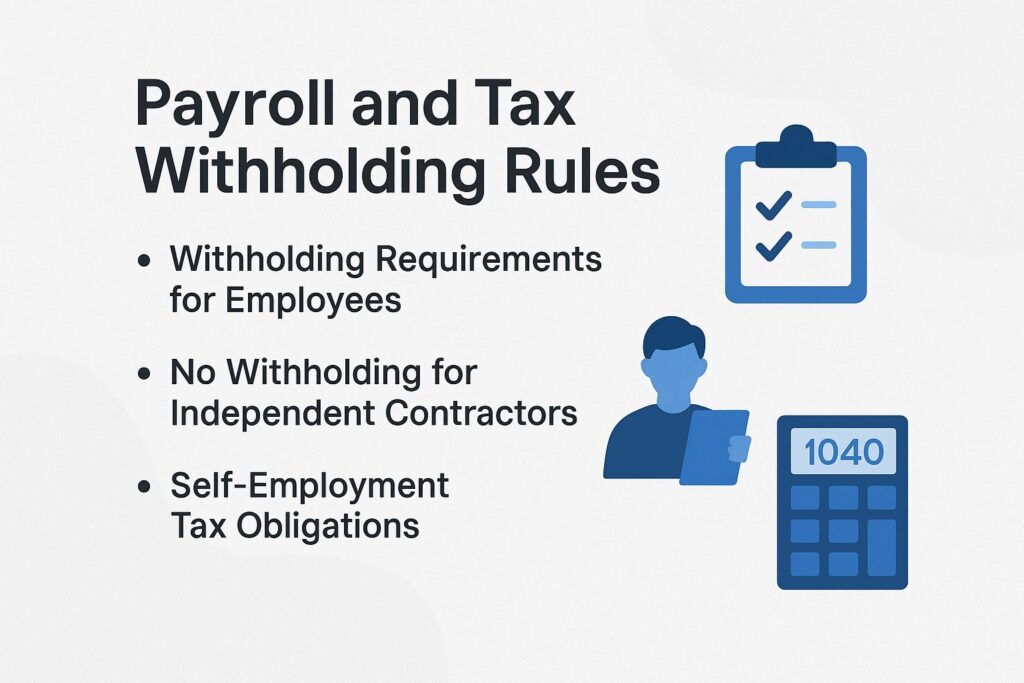
Under IRS rules, you must withhold 7.65% FICA taxes from employee paychecks, but contractors pay their own 15.3% self-employment tax on Schedule SE. Related insight: 7 Payroll Errors That Could Be Costing You Money and How to Repair Them
Withholding Requirements for Employees
For employees, you withhold federal income tax based on Form W-4 allowances, plus FICA, using tools like Gusto payroll software that automates 100% compliance for $40/month base.
To implement withholding effectively, follow these numbered steps as outlined in IRS Publication 15 (Circular E):
- Collect Form W-4 from each employee upon hiring to determine allowances.
- Calculate taxes using IRS withholding tables-for example, 10% on the first $11,000 of 2023 taxable wages for single filers.
- Deposit withholdings quarterly via EFTPS (Electronic Federal Tax Payment System) using your Employer Identification Number (EIN).
- Match FICA contributions (7.65% each for employer/employee).
Setup typically takes 1 hour. A common error is overlooking state taxes, like New York’s 5% rate-always check state-specific rules to avoid penalties.
Gusto integrates these seamlessly, reducing errors by 90% per user reports.
No Withholding for Independent Contractors
You pay independent contractors gross amounts without deductions, like $10,000 project fee via direct deposit, but must issue 1099 if over $600 annually.
Backup withholding applies only if the IRS notifies you of the contractor’s underreporting; otherwise, pay the full gross amount at the agreed rate of 24% if required. For instance, a freelance graphic designer might invoice monthly for $2,000 in services, which you pay net 30 days via ACH transfer without any deductions.
This approach offers pros like simpler administration, saving about 2 hours per month on payroll tasks, but cons include relying on the contractor to manage their own quarterly estimated taxes. For full details, refer to IRS Publication 1281 on backup withholding rules, ensuring compliance without unnecessary complications.
Self-Employment Tax Obligations
Independent contractors pay 15.3% self-employment tax on net earnings, deductible half on Form 1040, as a web developer earning $80,000 might owe $11,000 after expenses.
This rate breaks down to 12.4% for Social Security and 2.9% for Medicare taxes, calculated on Schedule SE and filed with your return.
To handle payments effectively, follow these steps:
- Track income and expenses using QuickBooks Self-Employed ($15/month), which categorizes transactions automatically for accurate net earnings.
- Estimate quarterly payments via Form 1040-ES, setting aside about 25% of net income-e.g., $5,000 per quarter for $80,000 earnings.
Maximize deductions like home office space: a 300 sq ft workspace in a 1,500 sq ft home allows a $1,500 annual deduction. Consult IRS Publication 334 for full guidance.
Reporting and Documentation
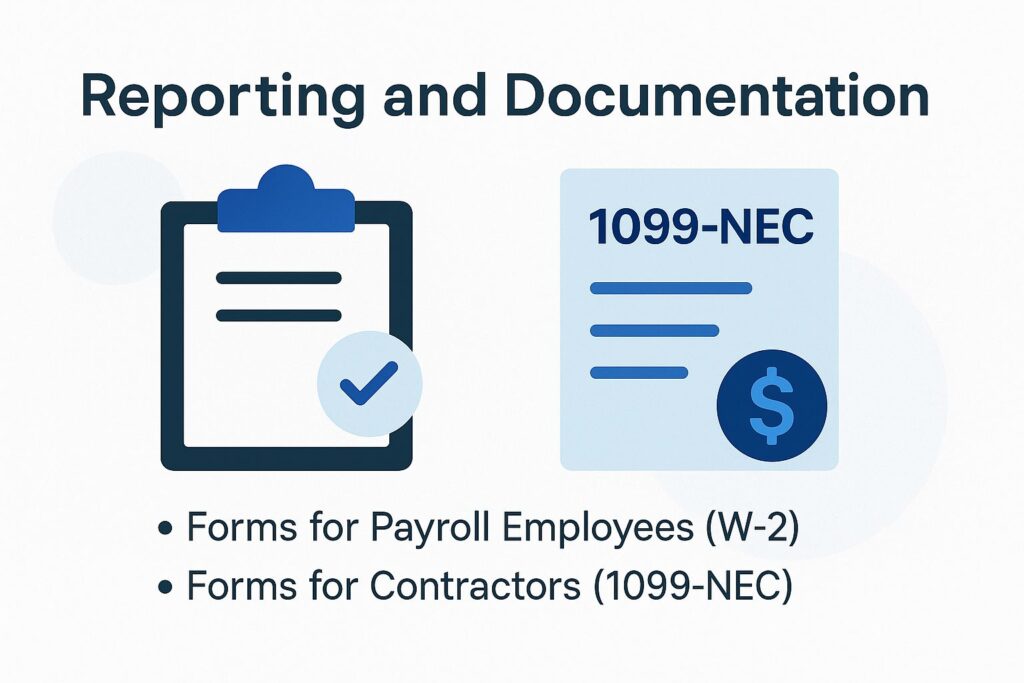
Proper reporting via W-2 for employees and 1099-NEC for contractors ensures compliance, with deadlines like January 31 for 2024 forms to avoid $50-$270 penalties per form.
Forms for Payroll Employees (W-2)
You issue Form W-2 to employees by January 31, reporting wages and withholdings, such as $50,000 salary with $3,800 FICA, using ADP software for automated generation at $10/employee/month.
Key boxes include Box 1 for total wages ($50,000), Box 2 for federal income tax withheld (e.g., $6,200), Box 3 for Social Security wages ($50,000), and Box 4 for Social Security tax ($3,100).
Box 6 shows Medicare tax withheld ($725). For state details, fill Boxes 15-17 with codes like NY-01 for New York withholding.
Follow these steps:
- Export payroll from QuickBooks to verify data.
- Generate via ADP or similar, cross-checking against IRS totals.
- E-file with SSA using EFW2, then distribute to employees.
Avoid omitting state info-a frequent error. See IRS Instructions for Forms W-2 for full guidance.
Forms for Contractors (1099-NEC)
For contractors paid $600+, file 1099-NEC by January 31, like reporting $5,000 to a consultant, with penalties up to $310 per late form per IRS 2024 rates.
Even multiple smaller payments, such as two $300 invoices totaling $600, trigger this requirement.
To comply, follow these steps:
- Collect Form W-9 from contractors at engagement start to verify TINs.
- Track payments using tools like Expensify ($5/user/month) for accurate records.
- E-file Form 1099-NEC via the IRS TIN Matching program, entering nonemployee compensation in Box 1.
Consult IRS Publication 1779 for independent contractor guidelines and the Form 1099 Instructions for detailed filing rules, ensuring penalty-free submission.
Risks of Misclassifying Workers
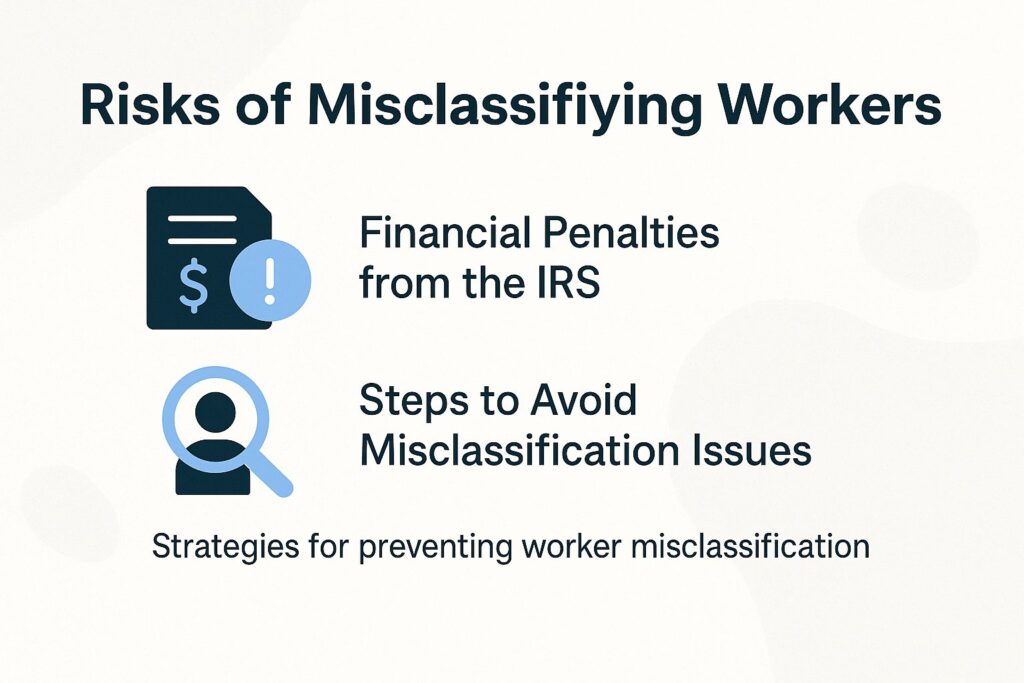
Misclassification risks IRS audits, NLRB (National Labor Relations Board) scrutiny, and penalties exceeding $25,000 per worker, as in the 2023 DoorDash settlement of $12.5 million for California drivers. To avoid these costly issues, implement proper classification practices using our Ultimate Employee Classification Checklist for 2025.
Financial Penalties from the IRS
The IRS imposes 100% of unpaid FICA plus 40% negligence penalty, totaling $14,000 for a $50,000 misclassified worker, per IRC Section 6672.
To mitigate risks from worker misclassification, break down the penalties clearly:
- Unpaid taxes cover the employer’s full FICA share (7.65% of wages, or $3,825 here).
- Interest accrues at 5% annually on balances due.
- Failure-to-file penalties add $310 per late Form 941.
- Willful disregard triggers personal liability up to the entire amount under IRC 6672.
The Vizcaino v. Microsoft case (9th Cir. 1997) resulted in $97 million for 8,000+ misclassified contractors.
For abatement, consult IRM 20.1, proving reasonable cause via documented legal advice or first-time errors, potentially reducing or waiving penalties through IRS appeals.
Steps to Avoid Misclassification Issues
To avoid issues, draft clear independent contractor agreements outlining scope and payment, reviewed by a tax advisor costing $300/hour, reducing audit risk by 70% per Deloitte study.
Take these five steps to classify correctly:
- Submit IRS Form SS-8 for free determination rulings, which take about 180 days but provide binding guidance.
- Use BambooHR’s classification checklist tool ($6/user/month) to evaluate workers against IRS behavioral, financial, and relationship factors.
- Train HR staff through SHRM online courses ($400 per participant) on misclassification risks and HR compliance.
- Do an annual audit with a labor lawyer to check contracts and compliance.
- Implement documentation controls, like avoiding company email access for contractors.
For borderline cases, adopt a hybrid model like using a Professional Employer Organization (PEO) combining elements of both classifications.
Reference DOL webinars on worker classification, including IRS guidelines and IRS rules for distinguishing employees from independent contractors using Form 1099 versus Form W-2, the SS-8 form for IRS determinations, compliance with FLSA (Fair Labor Standards Act) under the Department of Labor, obtaining an EIN (Employer Identification Number), handling Medicare taxes and FICA taxes, options like a PEO (Professional Employer Organization), considerations from the NLRB (National Labor Relations Board), and overall HR compliance strategies, for free resources and case studies.
About the Author
Kim Anderson is a Harvard University graduate with a bachelor’s degree in Accounting and Finance. She’s the owner of a successful payroll outsourcing firm based in California and a contributing writer for My Payroll Outsourcing. With 14 years of experience, Kim helps businesses streamline compliance, minimize administrative risk, and manage multi-state workforces with confidence.